WGI
WGI WHITEPAPER — 2026
Get the report

Built to Survive vs. Built to Last

Hurricanes are reaching inland. The tornado corridor is moving east. And the building code, by design, was never written to keep your facility running once the storm has passed. Here's what compliance leaves on the table, and what resilience actually looks like.

274tornadoes
Confirmed across the U.S. in Jan–Mar 2026 — the 3rd most active opening quarter on record.
NOAA Storm Prediction Center
200+ killed
Across six states from Hurricane Helene's inland reach in 2024.
National Hurricane Center
$8K→$30K
What a single storm-rated door costs at design vs. retrofitted into an occupied facility.
WGI structural engineering data
The difference is decided years before the storm

Two facilities. Two outcomes. Different storms. Different decisions.

Both buildings were standing when the clouds broke. Only one resumed operations. The difference wasn't the severity of the event — it was a set of decisions made years before either storm arrived.

Compliance, Not Continuity
December 10, 2021 • Edwardsville, IL

An EF3 tornado tore through a tilt-up warehouse.

Built in accordance with the 2006 IBC. Designed to get a permit — and it did. But EF3 winds (136–165 mph) significantly exceeded the design loads required for that occupancy. Roof diaphragm and wall panel connections failed.

Outcome: Six workers killed. No code violation. No construction defect. The building performed exactly to the loads it was designed to resist.
Engineered for the Mission
September 26, 2024 • Spartanburg County, SC

Hurricane Helene hit. The EOC didn't blink.

Opened in 2022 — designed from the start for exactly this scenario. Within hours, staffing scaled from 20 to 100+. The alternate 911 center came online. Generators held. Site access stayed passable.

Outcome: Three weeks of continuous storm recovery operations — without a single break in service.
A code-compliant building may stand — yet be unusable. Power may run emergency lighting but not core operations. Communications may fail despite intact structure. None of these outcomes violate the building code. They fall outside its scope entirely.
— From the whitepaper
The compliance trap

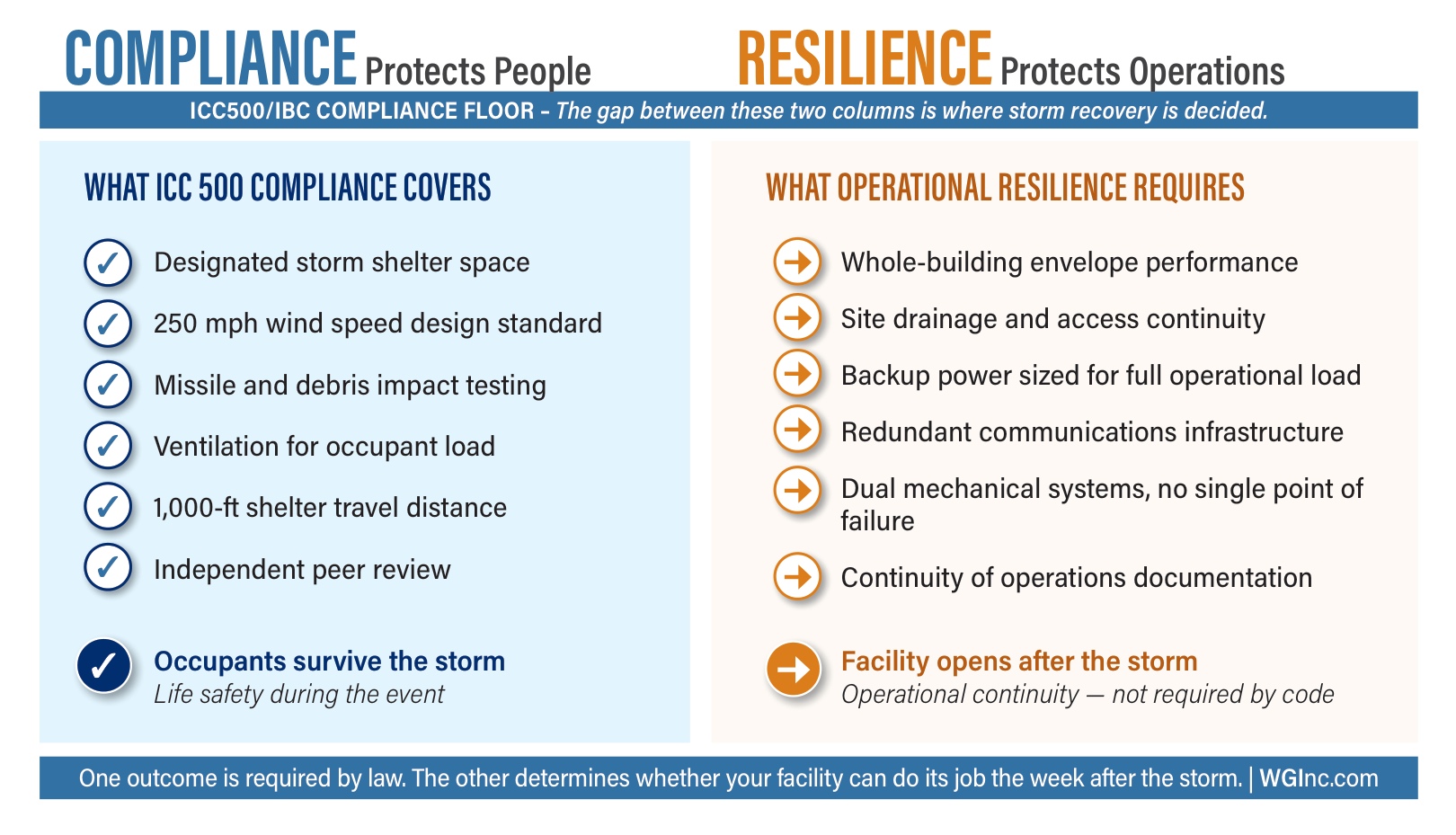
Compliance protects people. Resilience protects operations.

ICC 500 and the IBC are life-safety documents. They do exactly what they were written to do: keep occupants alive during an extreme wind event. They were never written to keep a 911 call center, a water plant, or a regional distribution facility running the week after the storm.

That gap — between life safety and operational continuity — is where storm recovery is decided.

Infographic comparing what ICC 500 compliance covers versus what operational resilience requires.
Figure 3 from the whitepaper: ICC 500 compliance vs. operational resilience. View full size →
What's inside

Six sections. Real outcomes. Engineering decisions that compound.

From shifting hazard maps to the funding conversation, this paper walks owners and capital planners through the design decisions that determine whether a building merely survives — or actually performs.

01

The Threat Is Bigger Than You Think

The tornado corridor has shifted east. Florida, Texas, and the Carolinas now face dual-hazard exposure across a single building's life.

02

What the Code Requires — and Where It Stops

ICC 500, IBC, ASCE 7, and what each one is, and isn't, designed to guarantee about your facility's performance.

03

The Compliance Trap

Why tilt-up, masonry, and cast-in-place don't equal storm-proof — and the pattern of gaps that show up when WGI assesses existing facilities.

04

What Resilience Actually Looks Like

Passive vs. active strategies, sequencing, and why the discipline boundaries (structural, MEP, civil, architectural) are where most failures originate.

05

When the Facility Cannot Go Dark

Risk Category IV as a foundation, not an endpoint. Case studies: Spartanburg EOC, Escambia–Santa Rosa Regional TMC, Palm Beach County.

06

The Funding Conversation

Insurance economics in coastal markets, total cost of ownership, and how to make the case for resilience investment before a storm forces it.

Visualized in the report

Built to be referenced — not just read.

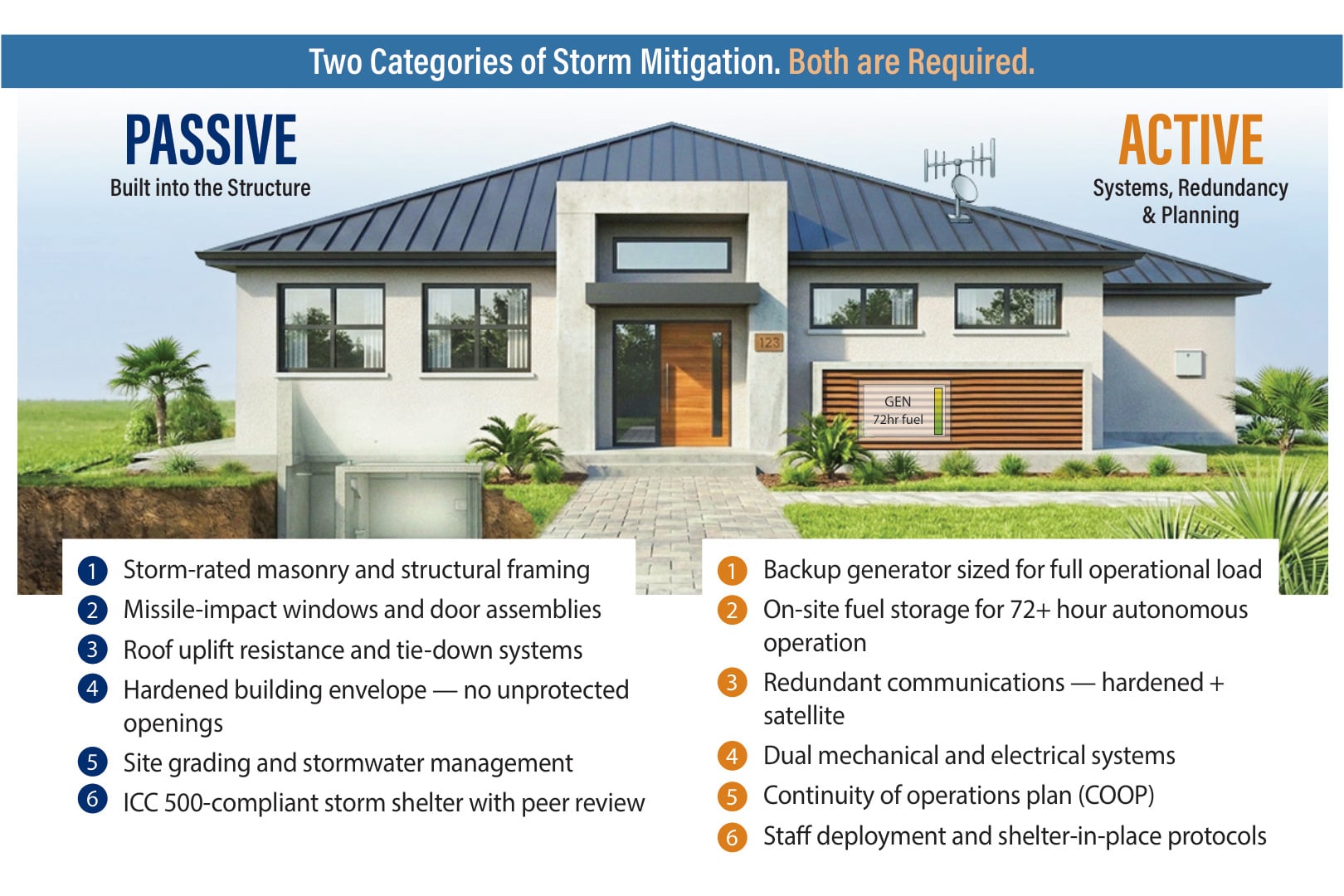
Diagram showing passive vs active storm mitigation strategies in a building.

Passive vs. Active Strategies, side-by-side.

Passive measures (load paths, envelope, impact-rated openings, site grading) must be built in from day one. Active measures (generators, fuel storage, redundant comms, COOP plans) can be layered — but only inside the limits passive design establishes.

Figure 4 from the whitepaper.

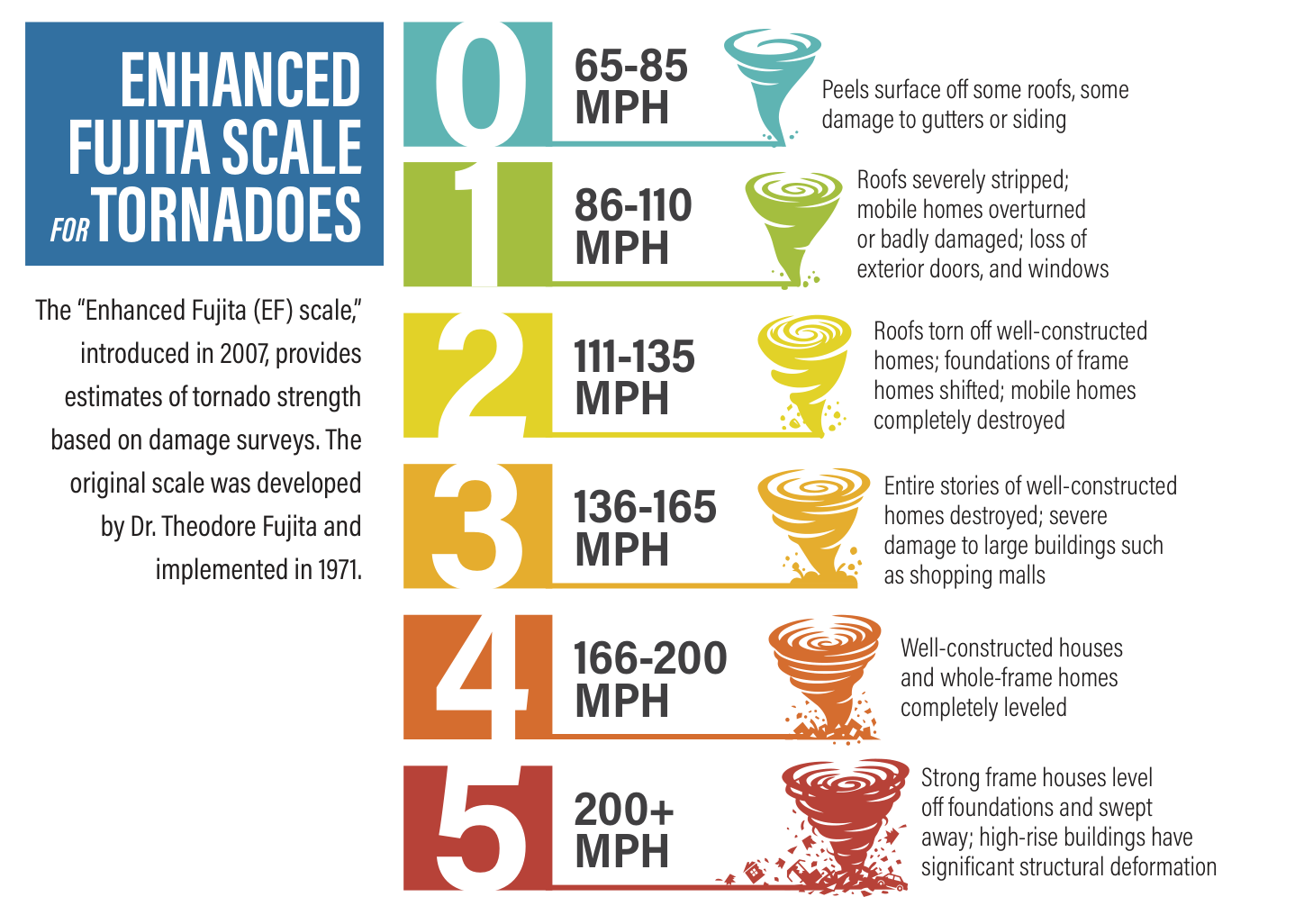
Enhanced Fujita scale infographic showing wind speeds and damage profiles from EF0 through EF5.

Where your facility actually sits on the EF scale.

EF3 winds (136–165 mph) routinely exceed the design loads required for conventional warehouse and office construction. The paper translates the EF scale into design decisions, not abstract numbers.

Figure 1 from the whitepaper. View full size →

Free download

Get the full whitepaper.

23 pages. Engineering depth. Real storm outcomes. The exact framework WGI uses to translate "must remain operational" into design decisions across structural, MEP, civil, and architecture.

  • Edwardsville, Spartanburg, Puerto Rico, Palm Beach County, and Escambia–Santa Rosa case studies.
  • What ICC 500 covers — and where its scope ends.
  • Passive vs. active strategy framework, with sequencing.
  • Total cost of ownership: design-time vs. retrofit math.
  • Hurricane + Tornado risk map for WGI's primary markets.
Download Your PDF + Interactive Flipbook

Built to Survive vs. Built to Last

Tell us where to send it. We'll never share your information.

By downloading, you'll receive the report by email. You can unsubscribe anytime.

Authored by

Two disciplines. One integrated approach.

Resilience failures almost never originate within a single discipline's scope. That's why this paper was written by structural and architectural leadership working in tandem — the same way WGI's teams design.

Robby Vogel, PE

Director of Structural Engineering

Robby leads WGI's structural engineering practice across hurricane and tornado country, with deep experience in ICC 500 storm shelter design, Risk Category IV facilities, and resilience assessments for county-owned facility portfolios.

Eric Luttmann, AIA

Director of Architecture

Eric directs WGI's architectural practice on essential facilities and continuity-of-operations projects, including emergency operations centers, traffic management centers, and Risk Category IV public infrastructure across the Southeast.

Hurricane season starts June 1.

The decision happens before the storm.

Download the whitepaper. Then, when you're ready, schedule a 30-minute conversation with Robby or Eric about your facility.

Get the whitepaper